Who Is Avalokiteshvara (Chenrezig)?
Avalokiteshvara, known in Tibetan as Chenrezig, is arguably the most venerated and beloved figure in all of Mahayana and Vajrayana Buddhism. His name translates to 'The Lord Who Looks Down with Pity,' referring to his unwavering commitment to witness the suffering of all sentient beings and offer boundless, unconditional compassion.
As a Bodhisattva, he represents the crystallization of the altruistic intention of all the Buddhas. According to tradition, Avalokiteshvara made a profound vow never to rest until he had freed every single being in all the realms of existence from the cycle of samsara. His energy is considered the very heartbeat of the Mahayana path, embodying the ideal that one's own liberation is incomplete without the liberation of others.
The 4-Armed Form: Shadakshari Lokeshvara
In Tibetan art, Avalokiteshvara is most commonly depicted in his tranquil, four-armed form known as Shadakshari Lokeshvara. He is brilliantly white in color, symbolizing pure, unblemished compassion. He sits in the full lotus posture upon a moon disc and a lotus throne.
His front two hands are clasped at his heart, holding a wish-fulfilling jewel that represents his profound bodhicitta (the mind of enlightenment). His raised right hand holds a crystal mala (rosary), symbolizing his continuous, untiring activity to liberate beings. His raised left hand holds a perfectly bloomed white lotus flower, representing his purity; although he reaches down into the mud of samsara to help beings, he remains entirely unstained by worldly faults.
The 1000-Armed, 11-Headed Emanation
One of the most visually spectacular manifestations in thangka art is the 1000-armed, 11-headed form of Avalokiteshvara. The legend states that Avalokiteshvara worked tirelessly to empty the hell realms. However, upon looking back, he saw that the realms were filling up again with suffering beings. Overwhelmed by grief, his head split into eleven pieces and his arms shattered.
Seeing his distress, Amitabha Buddha miraculously reassembled him, granting him eleven heads to hear the cries of the suffering in all directions, and a thousand arms to reach out and skillfully help them. In the palm of every single hand is an eye, symbolizing the perfect union of profound wisdom (the eye) and compassionate action (the hand).
The Power of the Om Mani Padme Hum Mantra
Avalokiteshvara is intrinsically linked to the six-syllable mantra, 'Om Mani Padme Hum,' the most widely recited mantra in the Tibetan Buddhist world. This mantra is considered the sonic manifestation of his compassion; to recite it is to invoke his presence directly.
The six syllables correspond to the six realms of existence (gods, demigods, humans, animals, hungry ghosts, and hell beings). Reciting the mantra is believed to purify the negative karma associated with these realms. 'Mani' means jewel, representing the method or compassion, while 'Padme' means lotus, representing wisdom. Thus, the mantra encapsulates the entire Buddhist path: the indivisible union of method and wisdom.
The Connection to the Dalai Lama and Tibetan Culture
In Tibet, Avalokiteshvara is not merely a distant spiritual ideal; he is considered the patron deity and spiritual progenitor of the Tibetan people. The physical landscape of Tibet, particularly the Potala Palace in Lhasa, is deeply associated with his pure land, Mount Potalaka.
Furthermore, the lineage of the Dalai Lamas, as well as the Karmapas, are believed by Tibetans to be direct earthly emanations of Avalokiteshvara. When a Tibetan venerates the Dalai Lama, they are actively venerating the living embodiment of Chenrezig's compassion on earth. This profound connection makes his image central to Tibetan cultural and religious identity.
Key Iconographic Attributes and Accompanying Deities
When analyzing a thangka of Avalokiteshvara, several key elements are consistent. He typically wears the silks and jewel ornaments of a royal prince, indicating his active engagement with the world. Over his left shoulder, he wears the skin of an antelope, symbolizing his deeply peaceful, non-violent nature.
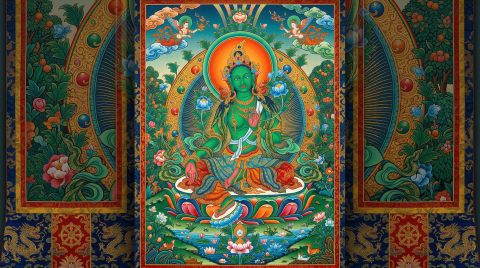
He is frequently depicted alongside other major figures. He is often flanked by Manjushri (Wisdom) and Vajrapani (Power), forming the 'Lords of the Three Families.' In his pure land depictions, he may be surrounded by Green and White Tara, who are emanations of his own compassionate tears, as well as the celestial Buddha Amitabha, who acts as his spiritual father and often sits upon his crown.
Meditating on Compassion Through AI Art Generation
Visualizing Avalokiteshvara is a foundational practice designed to cultivate deep empathy and bodhicitta within the practitioner. The intricate details of his forms—whether four-armed or thousand-armed—serve as focal points to anchor the wandering mind.
Using our AI generator, you can bring these magnificent forms to life. By entering detailed prompts describing his white complexion, his specific hand implements, and his radiant aura, the AI can generate breathtakingly detailed representations of Chenrezig. This provides modern practitioners and art enthusiasts with a powerful, accessible way to explore the visual majesty of the Bodhisattva of Compassion, inspiring a deeper connection to his timeless message of universal love.