Ancient Origins: From Indian Caves to Nepalese Pata
The visual language of Tibetan Thangka painting traces its earliest roots to the profound spiritual art of ancient India. The foundational aesthetics—such as the idealized proportions of the Buddha, the serene expressions, and the lotus thrones—can be seen in the murals of the Ajanta Caves dating back to the 2nd century BCE to 480 CE.
As Buddhism evolved, so did its need for portable religious icons. In India and the Kathmandu Valley of Nepal, artisans developed scroll paintings known as 'pata' or 'paubha.' The Newari people of Nepal became master craftsmen, developing a highly ornate and structurally rigorous style of devotional painting. These early Nepalese works heavily influenced the first generations of Tibetan artists.
The Arrival in Tibet: King Songtsen Gampo and Early Buddhism
The direct ancestor of the Thangka arrived in Tibet during the 7th century, a period of massive cultural transformation driven by the Tibetan Emperor Songtsen Gampo. His marriages to the Nepalese Princess Bhrikuti and the Chinese Princess Wencheng famously brought highly venerated Buddhist statues and artists to the Tibetan plateau.
In these early centuries, Tibetan art was highly derivative, closely mimicking the rigid, red-dominated palettes of Nepalese and Eastern Indian art. However, as Tibetan monasteries began to grow into massive centers of learning, the need for instructional and meditative art surged. The scroll painting format—perfect for nomadic tribes and traveling lamas—became the standard medium.
The Golden Age: Menri, Khyenri, and Karma Gadri Schools
Between the 15th and 18th centuries, Tibetan Thangka painting entered its Golden Age. Tibetan artists had fully assimilated foreign influences and began synthesizing them with indigenous aesthetics and Chinese landscape techniques. This era saw the codification of the major distinct schools of Tibetan painting.
The Menri school, founded by Menla Dondrub, introduced dynamic Chinese-style landscapes, flowing clouds, and asymmetrical space into the background of the deities. The Khyenri school focused heavily on intense, wrathful deities with highly detailed, almost explosive energy. The Karma Gadri school, originating in eastern Tibet, was known for its spacious, minimalist, and almost ethereal pastel landscapes that deeply reflected meditative calmness.
Regional Variations and Artistic Innovations
As Thangka art matured, variations appeared across the vast Himalayan region, from Bhutan to Ladakh, and Mongolia to Sichuan. Monasteries became massive patrons of the arts, commissioning sets of Thangkas that could number in the dozens or hundreds to depict the life of the Buddha, complex mandalas, or lineages of historical masters.
Innovations included the widespread use of pure gold applied as fine, hair-like highlights on robes and foliage. Appliqué Thangkas, made entirely of cut silk and brocade rather than paint, became monumental centerpieces for religious festivals, some large enough to cover the side of an entire mountain.
The 20th Century: Decline, Exile, and Revival
The mid-20th century marked the darkest period for Tibetan art. Following the political upheavals of the 1950s and the devastating Cultural Revolution in the 1960s and 70s, countless ancient Thangkas, texts, and monasteries were destroyed. The unbroken lineages of master painters faced extinction.
However, as Tibetan communities settled into exile in India, Nepal, and the West, a tremendous effort was mounted to preserve the art form. Institutions like the Norbulingka Institute in Dharamshala were established to train a new generation of artists in the strict, traditional iconometry and mineral pigment techniques, ensuring the survival of the sacred Menri and Karma Gadri styles.
The Modern Era and the AI Thangka Frontier
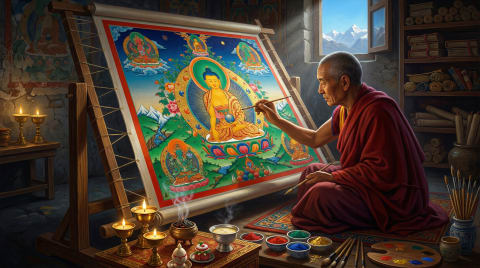
Today, Thangka painting exists both as a fiercely protected spiritual tradition and an internationally recognized fine art. Master painters continue to spend years grinding lapis lazuli and burnishing gold leaf in Himalayan workshops.
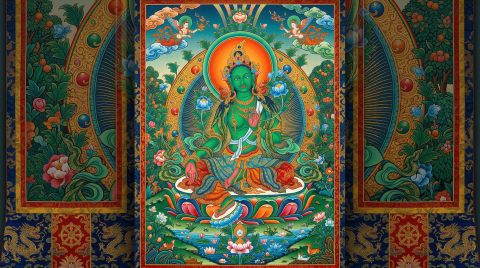
Simultaneously, we are witnessing the dawn of a new frontier: artificial intelligence. By feeding the strict iconometric rules, color symbolisms, and rich textures of traditional Thangkas into modern AI generators, a global audience can now interact with this sacred visual language. While AI generation does not replace the merit-making practice of hand-painting, it serves as a powerful educational and inspirational tool, allowing users to instantly visualize complex mandalas and deities, ensuring the visual legacy of Tibet continues to evolve in the digital age.