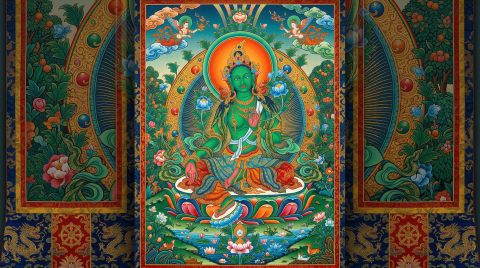
What is the Bhavachakra? An Overview
The Bhavachakra, or Buddhist Wheel of Life, is a diagram explaining how ignorance, karma, and mental afflictions sustain samsara—the cycle of birth, death, and rebirth. Its center shows the Three Poisons, the surrounding sections depict the Six Realms, the outer rim presents the Twelve Links of Dependent Origination, and Yama holds the entire wheel as a symbol of death and impermanence.
Often painted on the exterior walls of Tibetan monasteries and temples, the Bhavachakra functions as a visual teaching rather than a portrait of one deity or a historical scene. It maps the causes of suffering while showing that liberation is possible through understanding, practice, and awakening.
The Center: The Three Poisons
At the absolute center or hub of the wheel lie the 'Three Poisons,' the fundamental causes of all suffering in Buddhist philosophy. They are represented by three animals constantly chasing and biting each other's tails, illustrating how they endlessly fuel one another.
The pig represents ignorance or delusion, the fundamental misunderstanding of the nature of reality. The rooster represents attachment, greed, and clinging to what is pleasurable. The snake represents aversion, anger, and hatred toward what is unpleasant. As long as these three poisons drive the mind, the wheel of Samsara continues to turn.
The Middle Ring: The Six Realms of Existence
Radiating outward from the center are the Six Realms of Samsara, representing both psychological states of mind and literal realms of rebirth. They are divided into three 'higher' and three 'lower' realms.
The higher realms consist of the Gods (characterized by immense pleasure but ultimate decay), the Demi-Gods or Asuras (characterized by jealousy and endless war), and the Human realm (considered the most fortunate, as it holds the perfect balance of pleasure and pain needed to practice the Dharma). The lower realms are the Animal realm (driven by instinct and fear), the Hungry Ghost or Preta realm (characterized by insatiable craving), and the Hell realms (defined by immense physical and mental torment).
The Outer Rim: The Twelve Links of Dependent Origination
The outermost rim of the wheel is divided into twelve segments depicting the Twelve Links of Dependent Origination. This sequence details the exact mechanical process by which beings fall into suffering and rebirth, cause and effect.
It begins with a blind man walking with a cane, representing Ignorance. This leads to volitional action (a potter making pots), consciousness (a monkey swinging through trees), and eventually to birth (a woman giving birth) and aging and death (a corpse being carried). This chain shows that existence is not random, but a meticulously connected sequence of karmic events. Breaking just one link through spiritual practice causes the entire wheel of suffering to collapse.
Yama: The Lord of Death Holding the Wheel
The entire wheel is held firmly in the jaws and claws of a terrifying, wrathful monster. This is Yama, the Lord of Death, or impermanence. His presence is not meant to be inherently evil, but rather serves as a stark reminder of the inescapable truth: all conditioned things are impermanent, and death is certain.
Yama has three eyes, seeing the past, present, and future, and wears a crown of skulls. Above him, typically outside the wheel entirely, is a depiction of the Buddha pointing toward a moon or a pure land. This visual cue tells the viewer that liberation from Yama's grip is entirely possible through the path of awakening.
Visualizing the Wheel of Life with AI
The Bhavachakra is incredibly dense with symbolic data, making it a fascinating subject for AI generation. An accurate generation requires clear instructions on the structural layout: a central hub with animals, surrounded by six pie-shaped realms, encompassed by an outer rim of twelve vignettes, all held by a fierce demonic figure.
By feeding detailed prompts outlining these specific elements into a Thangka AI generator, creators can explore highly intricate, stylized interpretations of the Wheel of Life. Prompting for 'sacred geometry, symmetrical composition, rich Himalayan details, and wrathful deity features' helps the AI organize the complex narrative layers into a cohesive and visually stunning masterpiece.