Thangka Symbols at a Glance
A lotus represents purity arising from samsara; the vajra symbolizes indestructible reality and skillful means; the bell embodies wisdom and emptiness; and mudras reveal a deity's enlightened action. Halos express awakened radiance, while colors identify Buddha families and spiritual activities. Thrones and animal mounts communicate qualities such as fearlessness, stability, or transmutation.
Wrathful attributes such as skull cups, flames, and weapons do not celebrate violence: within their ritual context, they symbolize the transformation of ego, ignorance, and obstacles. Meanings can vary with the deity, lineage, tantra, and composition, so each symbol should be read as part of the complete image.
The Language of Thangka Iconography
Tibetan thangka painting is a highly codified visual language where nothing is left to chance or purely artistic whim. Every element on the canvas—from the angle of a finger to the color of a lotus petal, from the weapons held by a deity to the clouds in the background—carries specific philosophical and theological weight.
Understanding this iconography is crucial for both the practitioner and the art appreciator. To look at a thangka without understanding its symbols is like looking at a page of text written in an unknown language; one might appreciate the calligraphy, but the profound narrative remains hidden. Iconography acts as a bridge between the abstract concepts of Buddhist philosophy and the tangible world.
Mudras: The Sacred Hand Gestures of Enlightenment
Mudras are specific, highly stylized hand gestures that convey deep spiritual truths and the specific actions of the enlightened mind. They are central to identifying the deity and understanding their function.
For example, the 'Bhumisparsha mudra' (earth-touching gesture), where the right hand touches the ground, represents Shakyamuni Buddha's victory over the demon Mara and his calling of the earth to witness his enlightenment. The 'Dharmachakra mudra' (turning the wheel of dharma) involves both hands held at the heart, signifying the teaching of Buddhist doctrine. The 'Abhaya mudra' (gesture of fearlessness), with the right hand raised palm outward, offers protection and peace to the devotee.
Ritual Objects: Vajra, Bell, Lotus, and Beyond
Deities in thangkas frequently hold ritual implements that symbolize their unique powers and qualities. The most ubiquitous is the Vajra (Dorje in Tibetan), a stylized thunderbolt representing the indestructible, diamond-like nature of reality and the male principle of skillful means. It is often paired with the Ghanta (Bell), representing the female principle of the wisdom of emptiness.
The Lotus is a universal symbol of absolute purity; though its roots are in muddy water, its blossom opens pristine and unstained by the muck, perfectly mirroring the enlightened mind arising from the muck of samsara. Wrathful deities may hold skull cups (kapalas) filled with the blood of ego, or a flayed human skin representing the overcoming of ignorance.
The Deep Meaning of Color Symbolism
Color is never merely decorative in thangka art; it is a primary identifier of spiritual activity and cosmic alignment. The five primary colors correspond directly to the Five Buddha Families and their associated wisdoms.
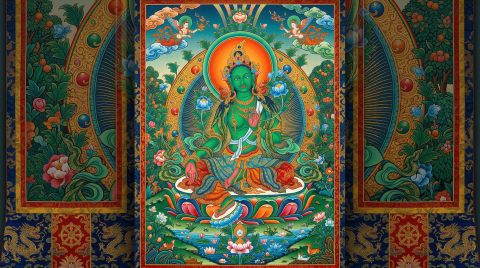
White represents pacification, purity, and the curing of illness (e.g., White Tara). Yellow/Gold signifies increase, prosperity, and spiritual wealth (e.g., Yellow Jambhala). Red represents magnetism, power, and the subjugation of negative forces (e.g., Amitabha or Kurukulla). Blue/Black denotes fierce, wrathful activity and the destruction of ultimate ignorance (e.g., Mahakala). Green represents swift action and the accomplishment of all karmic activities (e.g., Green Tara).
Thrones, Seats, and Animal Mounts
The support upon which a deity sits or stands provides crucial context about their nature. Peaceful Buddhas and Bodhisattvas almost always sit upon a moon disc resting on a fully blossomed lotus, symbolizing pure compassion and wisdom.
Wrathful deities often stand on a sun disc, representing fierce, blazing energy, and trample upon human or demonic figures that personify ignorance and ego. Many deities also have specific animal mounts (vahanas) associated with their Buddha family. Manjushri rides a snow lion, representing the fearless roar of truth; Samantabhadra rides an elephant, denoting steady, immovable strength; and Amitabha is supported by peacocks, birds believed to transmute poison into beauty.
Aureoles, Halos, and Emanating Light
The treatment of light is a hallmark of the thangka tradition. Deities are rarely shown casting shadows; instead, they are sources of light themselves. This is visually represented through intricate halos around the head and full-body aureoles (mandorlas).
Peaceful deities emit gentle, rainbow-colored auras or golden rays of light, symbolizing their pure, unhindered compassion radiating throughout the universe. Wrathful deities, conversely, are surrounded by the 'fire of primordial wisdom'—dynamic, swirling red and orange flames that consume the fuel of spiritual ignorance. These radiant backgrounds visually separate the sacred figures from the mundane landscape.
Decoding Thangka Art and Creating Your Own
By learning to read these iconographic elements, a thangka transforms from a visually overwhelming image into a precise map of spiritual technology. You begin to understand exactly what the deity is offering and what state of mind they represent.
With the AI Thangka Art Generator, you can actively experiment with this visual language. By purposefully including specific mudras, implements, and color combinations in your prompt, you direct the AI to construct deeply meaningful images. Requesting a 'blue-skinned wrathful deity holding a vajra surrounded by wisdom flames' will yield vastly different results than 'a golden Buddha in earth-touching mudra on a lotus throne,' allowing you to master the sacred vocabulary of the Himalayas.