The Foundational Geometry of the Universe
Sacred geometry is the belief that certain shapes, proportions, and mathematical ratios hold intrinsic divine meaning and are the fundamental building blocks of the universe. In Buddhist art, geometry is not merely an artistic tool for composition; it is a profound expression of Dharma—the underlying truth of reality.
From the sweeping curves of a stupa to the intricate grid of a mandala, geometric precision reflects the perfected, orderly state of an enlightened mind, standing in stark contrast to the chaotic, fragmented experience of ordinary, unenlightened existence. These mathematical forms serve as visual mantras, tuning the viewer's consciousness to a higher frequency of harmony.
The Lotus Pattern: Purity and Spiritual Unfolding
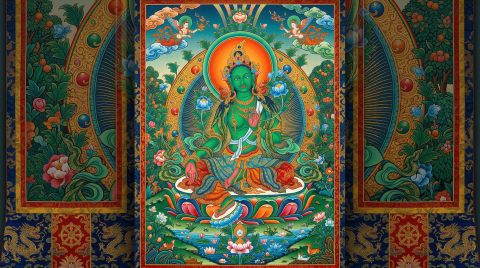
The lotus is perhaps the most ubiquitous geometric and organic symbol in Eastern spirituality. In sacred art, its geometry is deeply significant. The radial symmetry of a fully opened lotus blossom represents the complete unfolding of spiritual potential.
The petals are often depicted in specific numeric sequences—typically 8, 16, 32, or 64—which correspond to the energetic channels (nadis) meeting at the chakras within the subtle body. The eight-petaled lotus is intimately connected to the heart chakra and serves as the foundational seating for the major deities in a mandala, symbolizing unconditional love and the pure nature of the heart.
The Endless Knot and the Wheel of Dharma
Two of the Eight Auspicious Symbols in Buddhism are masterpieces of sacred geometry. The Endless Knot (Srivatsa) is a closed, geometric loop with no beginning or end. It mathematically visualizes the core Buddhist concept of dependent origination—the idea that everything in the universe is infinitely intertwined, and that wisdom and compassion must be perfectly united.
The Dharmachakra, or Wheel of Dharma, is a perfect circle representing the completeness of the Buddha's teachings. Its hub represents moral discipline, the eight spokes symbolize the Noble Eightfold Path, and the rim denotes meditative concentration holding the entire practice together.
Geometric Proportions in Deity Depiction
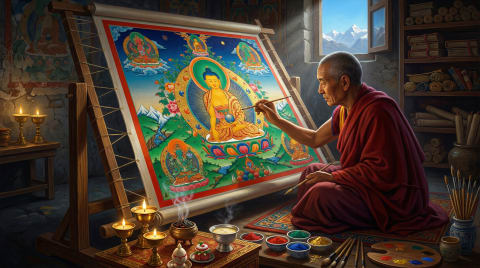
The drawing of Buddhas and Bodhisattvas is governed by the ancient science of iconometry (Tigse). Artists do not draw freehand; they construct complex geometric grids before applying a single drop of paint. These grids consist of a central vertical axis and multiple horizontal and intersecting lines.
Every aspect of the deity's anatomy is measured in fundamental units called 'sor' (the width of a finger). For instance, the length of a Buddha's face must be exactly equal to the width of the chest, and the full height of the body must equal the full span of the outstretched arms, creating a perfect square. This flawless geometric proportion ensures the deity visually embodies ultimate perfection.
The Architectural Harmony of Stupas and Mandalas
The stupa (or chorten in Tibet) is the ultimate architectural expression of Buddhist sacred geometry. Its shape is a 3D representation of the path to enlightenment and the five elements. The square base represents earth; the spherical dome represents water; the conical spire represents fire; the parasol represents air; and the crowning jewel represents space or consciousness.
Similarly, the mandala relies on the perfect balance of concentric circles intersecting with squares. The circle represents the dynamic, boundless nature of consciousness, while the square represents grounding, stability, and the physical realm. Together, they create a blueprint of the divine universe.
Mathematical Perfection and the Illusion of Form
There is a profound philosophical paradox embedded within Buddhist sacred geometry. While immense effort is expended to create perfectly measured, mathematically flawless representations of deities and mandalas, the ultimate teaching of Buddhism is 'Shunyata'—emptiness, or the lack of inherent, independent existence.
The geometry is a tool, a raft to cross the river of ignorance. By meditating on these perfect forms, the practitioner trains the mind in concentration and purity. However, upon achieving realization, the practitioner must recognize that even these perfect geometric forms are ultimately empty of inherent existence, dissolving the sacred shapes back into the pure, formless space of awareness.
Generating Sacred Geometry Using Modern AI
Replicating the exact ratios and complex symmetries of sacred Buddhist geometry by hand requires decades of training. Today, artificial intelligence possesses the unique capability to understand and instantly execute complex mathematical patterns and symmetries.
Through our AI generator, users can explore these ancient ratios. By prompting the AI for 'perfectly symmetrical eight-petaled lotus mandalas,' 'intricate endless knot patterns in gold,' or 'sacred geometric stupa blueprints,' the engine synthesizes traditional Tibetan aesthetics with algorithmic precision. This allows users to effortlessly generate captivating, mathematically harmonious art that honors the profound geometric traditions of Himalayan Buddhism.