The Core Meaning and Etymology of the Mandala
The word 'mandala' originates from the ancient Sanskrit language, loosely translating to 'circle' or 'center and its surroundings.' However, in the context of Vajrayana Buddhism, a mandala represents much more than a simple geometric shape. It is a profound spiritual map—a two-dimensional representation of a three-dimensional divine palace and the enlightened mind itself.
At its core, a mandala is a microcosm of the universe, illustrating the harmonious order that exists beyond the chaos of the material world. It serves as an idealized sanctuary, deeply imbued with symbolic meaning, guiding the practitioner from the outer edges of ignorance toward the glowing center of ultimate wisdom and enlightenment.
The Outer, Inner, and Secret Mandalas
In Buddhist philosophy, the mandala is understood on three distinct levels. The 'Outer Mandala' represents the external universe, including the physical cosmos, the elements, and the structured environment of Mount Meru, the sacred mountain at the center of Buddhist cosmology.
The 'Inner Mandala' corresponds to the practitioner's own physical body, with its subtle energy channels, chakras, and vital winds. Transforming one's body into a divine vessel is a key aspect of tantric practice. Finally, the 'Secret Mandala' represents the ultimate nature of mind itself—the pure, non-dual awareness that is the true source of all enlightenment, entirely free from conceptual limitations.
Architectural Structure: Circles, Squares, and Gates
When analyzing a visual mandala, one must understand its architectural blueprint. The structure typically begins with an outer ring of fire, symbolizing the burning away of ignorance. This is followed by a ring of vajras (thunderbolts) representing indestructible spiritual stability, and a ring of lotus petals symbolizing purity and spiritual rebirth.
Inside these protective rings lies a square palace with four distinct gates, aligned with the four cardinal directions. These gates are elaborate archways guarded by protective deities. The square represents the earth and physical stability, while the concentric circles represent the heavens and cosmic order. This intersection of circle and square is the foundational geometry of sacred space.
Types of Mandalas: Sand, Painted, and Architectural
Mandalas manifest in various physical forms depending on their ritual purpose. The most famous is the 'Dul-Tson-Kyil-Khor' or sand mandala. Monks spend days or weeks meticulously placing millions of grains of colored sand to form the intricate design. Upon completion, the mandala is deliberately swept away to vividly demonstrate the core Buddhist teaching of impermanence.
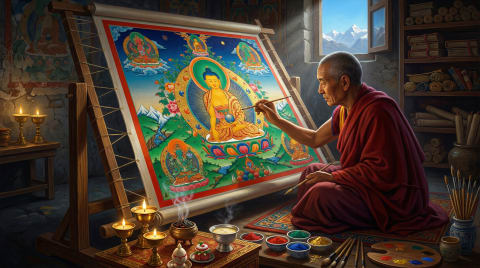
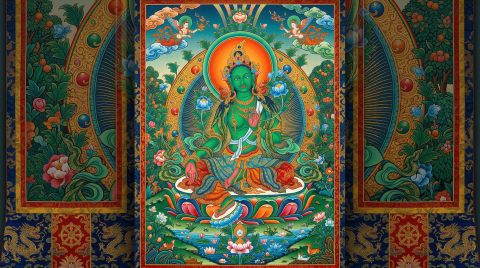
Painted mandalas on canvas (thangkas) are more permanent tools for meditation, designed to be hung in temples or personal shrines. Furthermore, entire architectural structures can be mandalas. The great stupa of Borobudur in Indonesia and the Samye Monastery in Tibet are physical, walkable mandalas constructed in stone and wood.
How to Read a Mandala's Sacred Journey
Reading a mandala is a journey from the profane to the sacred. The practitioner begins at the outer perimeter and visually navigates inward, passing through the protective rings which serve to purify the mind of worldly distractions and dualistic thoughts.
As the viewer moves through the four gates of the palace, they encounter various deities, each representing different aspects of enlightened consciousness. The colors of the four quadrants—typically blue, yellow, red, and green—correspond to the Five Wisdom Buddhas and their specific antidotes to mental poisons. Finally, the practitioner arrives at the exact center, the 'bindu,' which houses the principal deity, representing the pure, integrated state of enlightenment.
The Role of Mandalas in Tantric Meditation
In advanced Vajrayana meditation, the physical mandala is merely a blueprint for an intense mental exercise. Practitioners are trained to visualize the entire mandala in three dimensions within their own minds. They mentally construct the palace, place every deity in their exact location, and hold this complex image with unwavering concentration.
This practice is not merely an exercise in imagination, but a method of self-transformation. By repeatedly visualizing themselves entering the pure land of the mandala and merging with the central deity, practitioners gradually replace their ordinary, ego-driven self-perception with the pure, compassionate identity of an awakened being.
Exploring and Generating Sacred Geometry with AI
The mathematical precision and symbolic depth of mandalas make them incredibly compelling subjects for modern digital art. The strict symmetrical rules and intricate layering of traditional mandalas translate beautifully into algorithmic interpretation.
Using our AI Thangka Art Generator, you can explore this sacred geometry by inputting specific prompts related to elements, colors, and spiritual themes. The AI leverages its understanding of symmetry, proportion, and traditional Tibetan color palettes to construct unique, awe-inspiring mandalas. Whether you seek a visual aid for your meditation practice or wish to study the harmonious balance of Buddhist architecture, AI provides a powerful new tool for generating these cosmic maps.