Does Buddhism Have Deities? Understanding the Pantheon
Yes—but Buddhist deities are not independent creator gods in the Western sense. The Tibetan Buddhist pantheon includes Buddhas, Bodhisattvas, meditational deities, and fierce protectors, all understood within the path to awakening rather than as competing creators.
Instead, they are understood as manifestations of enlightened qualities—personifications of compassion, wisdom, power, and purification. They exist both as historical figures who achieved awakening and as psychological archetypes residing within the practitioner's own mind. Understanding the hierarchy, from supreme Buddhas to fierce protectors, is essential for decoding thangka art.
Buddhist Deities at a Glance: Pantheon and Roles
The term “Buddhist gods” is common in search, but it can be misleading. Buddhism does not organize these figures as a hierarchy of independent creator gods. In Tibetan Buddhism, the pantheon brings together Buddhas, Bodhisattvas, meditational deities, protectors, and other awakened or symbolic forms whose roles differ.
Buddhas embody complete awakening; Bodhisattvas such as Avalokiteshvara, Manjushri, and Vajrapani express compassion, wisdom, and spiritual power; Taras represent swift compassionate activity; Yidams are meditational deities used in authorized Vajrayana practice; Dakinis express awakened energy; and Dharmapalas protect the teachings and practitioners. The sections below explain these categories and show how their attributes identify them in thangka art.
The Supreme Buddhas: Shakyamuni and the Five Wisdom Buddhas
At the core of the pantheon are the Buddhas—beings who have achieved full, unexcelled awakening. Shakyamuni Buddha (the historical Siddhartha Gautama) is the most universally recognized, typically depicted in earth-touching posture wearing simple monastic robes, symbolizing his earthly presence and historical reality.
In Vajrayana, the concept expands to include the Five Wisdom Buddhas (Dhyani Buddhas), representing the five qualities of the Buddha mind. Vairochana (center, white), Akshobhya (east, blue), Ratnasambhava (south, yellow), Amitabha (west, red), and Amoghasiddhi (north, green). These celestial Buddhas are often depicted adorned with crowns and jewels, existing in pure realms beyond historical time.
Bodhisattvas: The Embodiment of Compassionate Action
Bodhisattvas are practitioners who generate bodhicitta—the aspiration to attain Buddhahood for the benefit and liberation of all beings. In Mahayana, they are not simply defined as beings who “postpone Nirvana”; the bodhisattva path unites wisdom and compassion, directing every practice toward the awakening of all beings.
Visually, Bodhisattvas are depicted in royal attire, wearing elaborate thirteen-part ornaments, crowns, silks, and jewels, symbolizing their active engagement with the world. The most prominent include Avalokiteshvara (Bodhisattva of Compassion), Manjushri (Bodhisattva of Wisdom, wielding a flaming sword), and Vajrapani (Bodhisattva of Power, holding a vajra). Together, these three form a crucial trinity in Tibetan art.
Taras: The Mothers of Liberation
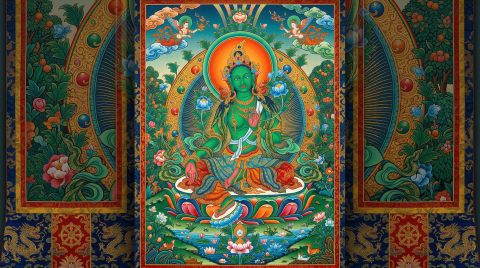
Tara, known as the 'Mother of Liberation,' holds a profoundly special place in Tibetan Buddhism. Legend states she was born from the tears of Avalokiteshvara as he wept for the suffering of the world. Tara represents the active, swift, and nurturing aspect of compassion.
She manifests in 21 primary forms, each associated with a specific color and spiritual activity. The most widely venerated are Green Tara, known for her swift protection and readiness to spring into action (indicated by her right leg stepping down from her lotus throne), and White Tara, associated with longevity, healing, and deep pacification, depicted with seven eyes on her hands, feet, and forehead.
Dharmapalas: The Fierce Protectors of the Teachings
Perhaps the most visually striking and misunderstood figures in thangka art are the Dharmapalas, or Dharma Protectors. These wrathful deities are depicted surrounded by flames of primordial wisdom, wearing garlands of severed heads, brandishing weapons, and trampling upon ignorance and ego.
Despite their terrifying appearance, their wrath is not driven by anger, but by fierce, uncompromising compassion. Like a protective parent forcefully stopping a child from running into traffic, the Dharmapalas destroy inner and outer obstacles to enlightenment. Key figures include Mahakala (the Great Black One) and Palden Lhamo, the principal female protector of Tibet.
Dakinis and Yidams: Partners in Tantric Transformation
Dakinis, often translated as 'sky dancers,' are dynamic, female manifestations of enlightened energy. They are the muses of the spiritual path, representing the ever-changing flow of energy and the pure, unconditioned nature of mind. Vajrayogini and Kurukulla are prime examples, often depicted in dancing postures, drinking from skull cups.
Yidams are personal meditational deities bound to a practitioner through tantric initiation. A Yidam can be peaceful or wrathful, male or female. The practitioner uses the Yidam as a mirror, meditating upon the deity's form to directly experience their own innate Buddha-nature.
Visualizing the Divine: From Mind to AI Canvas
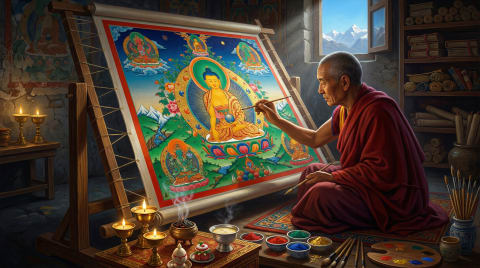
Visualizing these complex deities with perfect clarity is a demanding spiritual practice that requires intense concentration and a deep understanding of iconography. Traditional thangkas serve as essential guides for this visualization process.
Our AI Thangka Art Generator provides a novel way to interact with these divine forms. By carefully structuring your prompts—specifying the deity, their color, posture, implements, and surrounding aura—you can utilize the AI to render breathtaking, highly detailed visualizations. This tool honors the intricate descriptions found in traditional texts, allowing modern users to generate awe-inspiring representations of Buddhas, Bodhisattvas, and fierce protectors in exquisite resolution.