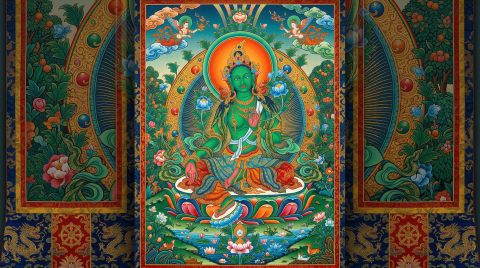
The Definition and Spiritual Purpose of Thangkas
A thangka, variously spelled as tangka, thanka, or tanka, is a traditional Tibetan Buddhist scroll painting usually created with mineral pigments on cotton cloth or made as silk appliqué. More than just a decorative piece of art, a thangka is profoundly sacred—it serves as a powerful visual aid for spiritual practice, meditation, and instruction.
The word 'thangka' translates roughly to 'that which can be rolled up,' indicating its original purpose as a portable shrine for nomadic monks and practitioners traversing the harsh Himalayan terrain. These scroll paintings function as a medium through which the practitioner can visualize deities, historical figures, and intricate mandalas. When unrolled, a thangka acts as a focal point for veneration, a mirror reflecting the practitioner's own potential for enlightenment, and a window into the divine realm.
The Origins and Evolution in Tibet and Nepal
The tradition of thangka painting finds its roots in early Buddhist art from India and the Kathmandu Valley of Nepal. As Buddhism spread across the Himalayas into Tibet around the 7th and 8th centuries, it brought with it the rich artistic traditions of Indian scroll painting (pata) and Nepalese paubha art.
Tibetan artisans absorbed these influences, gradually infusing them with indigenous Bon aesthetics and later, Chinese landscape techniques. The result was a uniquely Tibetan synthesis that reached its zenith between the 15th and 18th centuries. The Newari artists of Nepal played a particularly crucial role in this evolution; their masterful craftsmanship was highly sought after by Tibetan monasteries.
Materials and Creation Process: Pigments, Gold, and Silk
The creation of a traditional thangka is a painstaking, merit-making endeavor that can take months or even years to complete. The process begins with the preparation of the canvas, typically a finely woven cotton cloth. This canvas is stretched tightly over a wooden frame, treated with a mixture of chalk and animal glue (gesso), and polished with a smooth stone or glass until it achieves a glass-like surface.
The painting itself relies on natural, hand-ground mineral and organic pigments. Malachite yields brilliant greens, azurite provides deep lapis blues, cinnabar creates vibrant reds, and realgar offers striking oranges. The final, most crucial step involves the application of pure 24-karat gold leaf, used to highlight divine ornaments, halos, and rays of light.
The Strict Rules of Sacred Proportion
In thangka painting, the artist's personal expression is secondary to precise iconographic accuracy. The layout and proportions of deities are dictated by strict geometric grids established in ancient Sanskrit texts, known as the Shilpa Shastras, and later Tibetan iconometric treatises.
These grids ensure that every feature—from the curve of a lotus petal to the distance between a Buddha's eyes—aligns perfectly with sacred mathematical ratios. This rigid adherence to sacred geometry is not meant to stifle creativity, but to guarantee the efficacy of the thangka as a spiritual tool. A perfectly proportioned deity is believed to become a suitable receptacle for divine presence.
Types of Thangkas: From Painted to Appliqué
While the brightly painted canvas thangka (bris-tang) is the most recognizable form, the tradition encompasses several other distinct types, each utilizing different materials and techniques. The nagtang, or 'black thangka,' features gold and vibrant colored lines painted on a solid black background, typically reserved for wrathful deities and advanced tantric practices.
Beyond painted thangkas, the go-ku or appliqué thangka represents a monumental achievement in textile art. These are created by meticulously stitching together hundreds of pieces of colored silk to form the deity's image. Appliqué thangkas are often enormous—sometimes several stories high—and are traditionally unrolled down the sides of monastery walls during major religious festivals.
How Thangkas Are Used in Meditation and Ritual
Within Vajrayana Buddhism, a thangka is not viewed as a static image, but as a dynamic spiritual technology. Through a ritual called 'rabney,' high lamas consecrate the thangka, inviting the actual presence or 'wisdom being' (yeshepa) of the deity to reside within the image.
For the practitioner, the thangka serves as a crucial aid in 'Generation Stage' meditation. The meditator stares intently at the image, memorizing every minute detail—the colors, the implements, the jewelry, the posture—until they can perfectly visualize the deity in their mind's eye without looking at the painting. Thangkas are also central to ritual offerings, serving as the focal point for prostrations and mantra recitation.
Modern Relevance and Creating Thangkas with AI
Today, the ancient art of thangka painting is navigating the complexities of the modern world. While master painters continue the rigorous traditional lineage in places like Dharamshala and Kathmandu, thangkas have also garnered global appreciation as exquisite works of fine art.
The emergence of artificial intelligence offers a fascinating new frontier for engaging with this sacred art form. Our AI Thangka Art Generator allows users to explore the vast iconographic vocabulary of Tibetan Buddhism, combining traditional motifs, sacred geometry, and mineral-like color palettes in real-time. By providing descriptive text prompts, anyone can generate stunning visualizations of deities and mandalas to inspire their spiritual and artistic journey.