Who is Green Tara?
Green Tara (Syamatara in Sanskrit, Drolma Jang in Tibetan) is one of the most beloved and revered figures in Tibetan Buddhism. She is considered a fully enlightened female Buddha and the very embodiment of universal compassion, actively stepping forth to relieve the suffering of all sentient beings.
According to myth, Tara was born from the compassionate tears of Avalokiteshvara (Chenrezig). As he wept over the immense suffering of the world, his tears formed a lake where a lotus bloomed. From this lotus emerged Tara, promising to help Avalokiteshvara in his endless task of liberating beings. While White Tara is associated with longevity and pacification, Green Tara is specifically known for her swift, dynamic action and protection from fear and obstacles.
Her Iconography: Posture, Color, and the Utpala Lotus
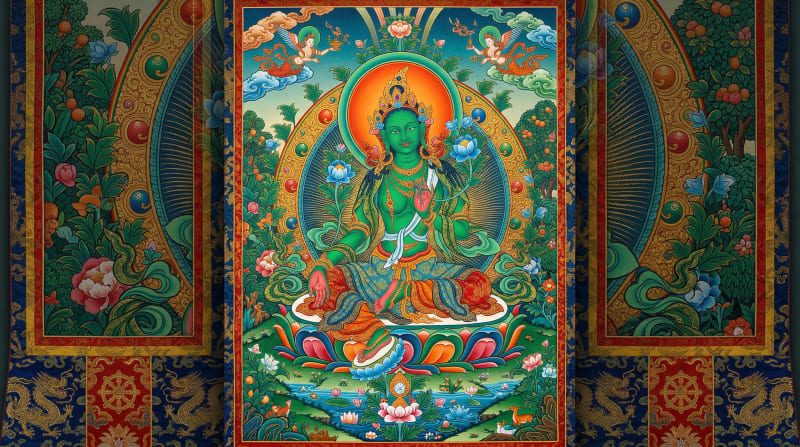
In Thangka art, every aspect of Green Tara's depiction carries profound symbolic meaning. She is typically painted in a vibrant emerald green, a color that symbolizes vital energy, active compassion, and an immediate readiness to act. This green hue connects her to the Amoghasiddhi Buddha and the wind element, reflecting her swiftness.
Her distinctive posture, known as 'lalitasana' or the posture of royal ease, is a key identifier. Her left leg is folded inward in a state of meditative tranquility, while her right leg is extended outward, foot resting on a small lotus. This indicates that while her mind remains in a state of absolute enlightenment, she is always ready to step out into the world of suffering to help beings.
Her hands hold the stems of the utpala (blue night lotus), which blossom beside her shoulders. The lotuses typically feature three stages of growth—a bud, a fully open flower, and a withered blossom—representing the Buddhas of the past, present, and future. Her right hand is in the varada mudra (gesture of supreme generosity), and her left hand is in the vitarka mudra (gesture of teaching or refuge).
The 21 Forms of Tara: A Spectrum of Compassion
While Green Tara is the primary and most commonly depicted form, the Tara pantheon expands into the '21 Taras.' These emanations represent the various qualities and activities needed to benefit sentient beings. Some are peaceful and smiling, designed to pacify illness and conflict, while others are semi-wrathful or fully wrathful, manifesting fierce energy to destroy negative forces and spiritual obstacles.
The Praises to the 21 Taras is a widely practiced liturgy in Tibetan monasteries and households. In Thangka paintings, Green Tara is often depicted centrally, surrounded by smaller, distinct figures of the other 20 Taras, forming a beautiful and mathematically precise sacred mandala of female enlightenment.
The Mantra: Om Tare Tuttare Ture Soha
The heart of Green Tara practice is her mantra: 'Om Tare Tuttare Ture Soha.' Recited by millions daily, it is believed to carry the acoustic essence of her enlightened mind. Each syllable carries a specific transformative power meant to overcome different types of fears and emotional afflictions.
'Om' represents the enlightened body, speech, and mind. 'Tare' liberates from cyclic existence (samsara) and true suffering. 'Tuttare' liberates from the eight great fears (such as pride, ignorance, and anger). 'Ture' liberates from physical and mental disease, bringing spiritual success. Finally, 'Soha' establishes the root of the path within the heart, sealing the mantra's blessing.
Green Tara's Role in Meditation and Practice
In Vajrayana Buddhist meditation, a practitioner does not merely worship Green Tara from afar but seeks to identify entirely with her enlightened qualities. Through Deity Yoga (generation stage meditation), the practitioner visualizes themselves in the radiant green form of Tara, adopting her pure compassion and wisdom as their own.
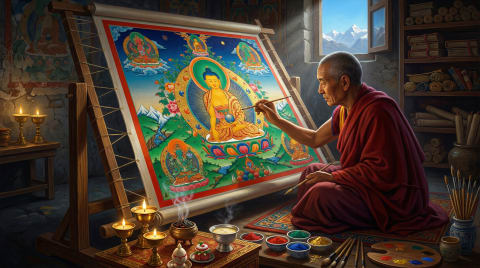
A visual support, such as a traditional Thangka, is essential for this practice. The meditator studies the Thangka extensively, internalizing every detail of her ornaments, posture, and expression until the image can be held clearly in the mind's eye. This perfect visualization serves to purify ordinary perception and awaken the practitioner's inherent Buddha-nature.
Creating Green Tara Art with AI
The precision required to create a traditional Green Tara Thangka is immense, governed by strict iconometric grids. With the advent of AI Thangka generators, users can now explore these sacred dimensions by crafting detailed text prompts.
When generating Green Tara, it is crucial to specify her emerald green skin, her unique posture with the right leg extended, and the blue utpala lotuses at her shoulders. By combining these traditional iconographic rules with AI-driven artistic rendering—such as specifying 'mineral pigment textures,' 'gold leaf highlights,' and 'Himalayan landscape background'—practitioners and artists alike can create breathtaking, spiritually resonant modern interpretations of the Mother of all Buddhas.