The Five Wisdom Colors: An Overview
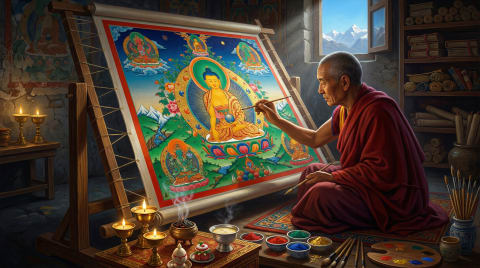
In traditional Tibetan Thangka painting, color is never chosen arbitrarily or purely for aesthetic appeal. Every hue is a coded language carrying profound spiritual, philosophical, and psychological significance. The palette is deeply anchored in the 'Five Wisdom Colors' (Pancha-varna)—white, blue, yellow, red, and green.
These primary colors map directly to the purification of human afflictions. Each color represents the transformation of a specific negative emotion (such as anger, greed, or ignorance) into its corresponding enlightened wisdom. Understanding this color vocabulary is essential for both the artist who paints the Thangka and the practitioner who uses it for meditation.
Buddhist Color Meanings at a Glance
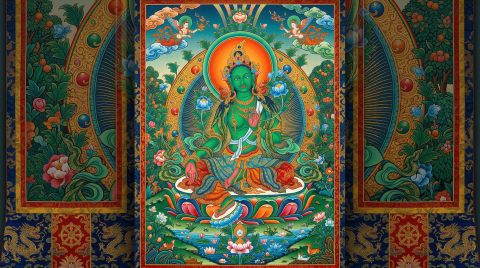
In the Tibetan five-color system, white commonly signifies purity and the transformation of ignorance; blue represents vastness and mirror-like wisdom; yellow expresses stability, abundance, and equanimity; red conveys compassion, magnetizing activity, and discriminating wisdom; and green signifies balance, swift action, and all-accomplishing wisdom.
These meanings are not a universal code for every Buddhist culture or artwork. Their precise associations depend on the deity, ritual cycle, lineage, and artistic context. In a thangka, color should therefore be read together with posture, implements, mudras, and the figure’s place in the composition.
What Was Buddha's Favourite Colour?
Buddhist traditions do not establish one universal favourite colour for the historical Buddha. Colours in Buddhist art vary by culture, lineage, deity, ritual cycle, and artistic context; they express enlightened qualities rather than a personal preference attributed to the Buddha.
It is therefore more accurate to ask what a colour symbolizes in a particular image. In Tibetan art, white, blue, yellow, red, and green correspond to different wisdom qualities and Buddha families, while black and gold carry additional ritual and artistic meanings.
Color and the Five Dhyani Buddhas
The five colors are intrinsically linked to the Five Dhyani Buddhas (Tathagatas), who represent the five qualities of the Buddha.
White is associated with Vairochana, representing the transformation of ignorance into the wisdom of ultimate reality. Blue connects to Akshobhya, transmuting anger into mirror-like wisdom. Yellow belongs to Ratnasambhava, turning pride into the wisdom of equanimity. Red is the color of Amitabha, transforming desire and attachment into discriminating wisdom. Finally, Green is linked to Amoghasiddhi, converting jealousy into all-accomplishing wisdom. When you see a deity painted in one of these colors, you immediately know their spiritual lineage and core energetic function.
The Sacred Significance of Gold Leaf
Gold is arguably the most sacred and highly valued material in traditional Thangka creation. It is not merely a color but a physical offering of light and purity. In Buddhist philosophy, gold symbolizes the absolute, unchanging nature of enlightenment, as it does not tarnish or corrupt over time.
Thangka painters use pure 24-karat gold ground into a fine powder and mixed with a binder. It is applied to the halos, the intricate patterns of the deities' brocade robes, and the sacred ritual implements. The gold is then burnished with an agate stone to achieve a brilliant, radiant shine. This luminosity is meant to visually simulate the divine radiance of the Buddha's enlightened mind.
Nagtang: The Power of Black Thangkas
While most Thangkas are painted on a brightly colored or white-primed canvas, the 'Nagtang' or black Thangka is a unique and deeply striking sub-genre. In these paintings, the background is entirely black, and the subjects are outlined in luminous gold or vibrant primary colors.
Black in Tibetan Buddhism symbolizes the ultimate emptiness, the unmanifested state of reality, and the destruction of ignorance. Nagtang Thangkas are typically reserved for wrathful deities (Dharmapalas) and advanced tantric practices. The stark contrast of gold against black creates a terrifyingly beautiful aesthetic, meant to shock the practitioner out of ordinary dualistic thinking and into pure awareness.
Mapping Colors to Elements, Directions, and Chakras
The sacred color system of Tibet is a vast interconnecting web that ties the internal body to the external universe. The five wisdom colors correlate directly to the five elements: White (Water), Yellow (Earth), Red (Fire), Green (Air/Wind), and Blue (Space or Ether).
Furthermore, these colors map to the cardinal directions in the construction of a mandala. Typically, East is white or blue, South is yellow, West is red, North is green, and the Center is blue or white depending on the specific tantra. In subtle body practices, these colors are also visualized at specific chakras (energy centers) along the central channel to purify physical and subtle energies during meditation.
Using Color in AI Generation
When generating Thangka art using AI, understanding this color symbolism allows for prompts that are not only visually striking but culturally and spiritually accurate. By intentionally selecting palettes based on the Five Dhyani Buddhas, creators can infuse their digital art with traditional meaning.
Prompts that specify 'mineral pigments,' 'lapis lazuli blue,' 'cinnabar red,' or '24k gold leaf highlights' instruct the AI to mimic the authentic, matte-yet-radiant textures of physical Thangkas. Alternatively, prompting for 'Nagtang style, black background with gold linework' will yield intense, mystical visuals perfect for wrathful deity manifestations.